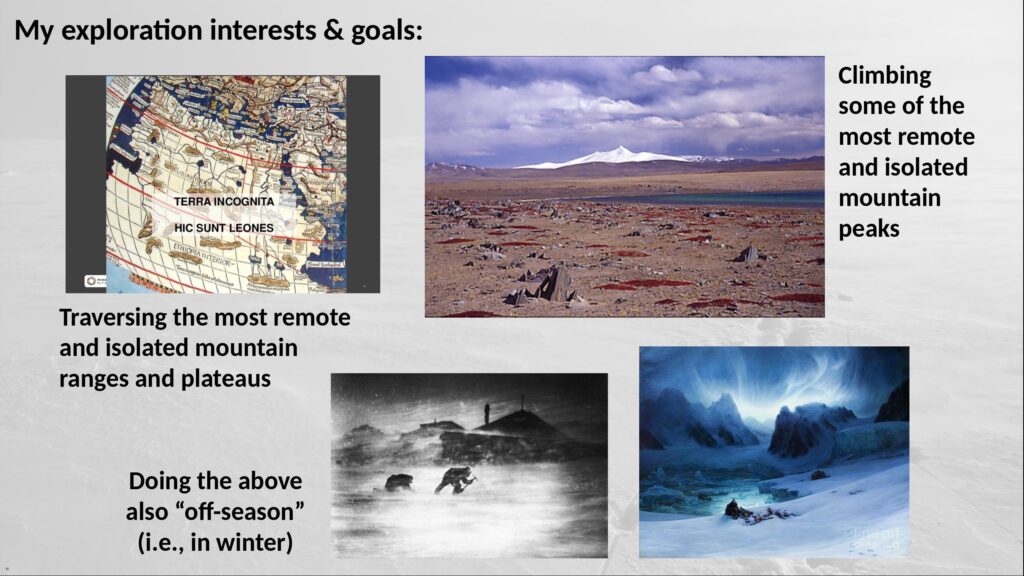
I am interested in solving difficult and multifaceted problems in exploratory mountaineering and in polar exploration in the coldest and the most remote & hard-to-reach mountain ranges and plateaus. In practice, this usually means organizing and executing expeditions rich in logistical, physical, mental, and intellectual challenges; goals of such expeditions are usually climbing unclimbed mountains and crossing uncrossed plateaus and ranges. I target (1) the coldest peaks in the coldest time of the year, where absolute temperatures can drop to -70 C, and (2) the most remote and hard-to-reach places in absolute wastelands which can be more than 500 kilometers away from nearest human outposts. Finally, almost all my expeditions are solo, unsupported, and unassisted, which in practice means relying only on one’s own resources and strength in the field.
I am simultaneously a scientist at ETH Zurich, where I lead research on sparse graph computations and large language models at the Scalable Parallel Computing Lab (SPCL); I also work on network topologies and occasionally other aspects of the high-performance computing landscape. If you are interested, a link to my personal research focused website is at the bottom of this page.
In addition to being interested in exploration for the sake of it, I also use expeditions as a driver of more effective and efficient research. Specifically, my expeditions develop personality strength, mental resilience, perseverance and tenacity, resourcefulness, resistance to stress, and leadership skills. They have greatly enhanced my research activities: all the mental and psychological resources developed and trained in very hostile environments can be directly reused when tackling demanding deadlines and any other research challenges. The expeditions are also a great lesson in efficient risk management and decision making: one must learn how to quickly and efficiently make many decisions that may have important consequences: a bad decision may lead to death, a good decision may save one’s life. Here, solo expeditions are of particular value: one learns how to fully rely on oneself, not take anything and anyone for granted, and take full responsibility for one’s actions.
While I am interested in several very remote and cold regions of the world, which still offer numerous unresolved serious exploratory problems, so far I have mostly focused on the mountains and plateaus of North Siberia and Siberian Arctic. This is because this is a hostile and unyielding environment, very challenging, virtually unexplored, and completely pristine in most parts. Both summers and winters come with numerous mental and physical challenges related to weather, climate, terrain, for example: deep valleys full of swampy and impassable taiga forests, vast, gloomy, and severe plateaus with ferocious winds, unexplored crevassed glaciers, violent and wide rivers, grey and bleak polar deserts, endless marshy tundra, sheer cliffs and deep canyons (sometimes deeper than 1000 meters), technically demanding mountain ridges and faces, temperatures as low as -70 C (without the windchill factor, it can get much colder than that with the wind) and as high as +40 C, deep, soft, and unstable snow, vast fields of sharp stones, wild animals, ultimate isolation and solitude, and many others.
Finally, I also work scientifically on enhancing the general efficiency and effectiveness of a broad range of exploratory undertakings (scientific expeditions, athletic expeditions, any other ventures related to off-road hostile terrain and settings etc.) with computing and deep learning.
The name of the website, “Exploratio Terrae Incognita”, means in Latin “The Exploration of the Unknown Lands”.
>>> Check out the best photos here.
>>> Check all expeditions here.
Selected explored mountains and plateaus:
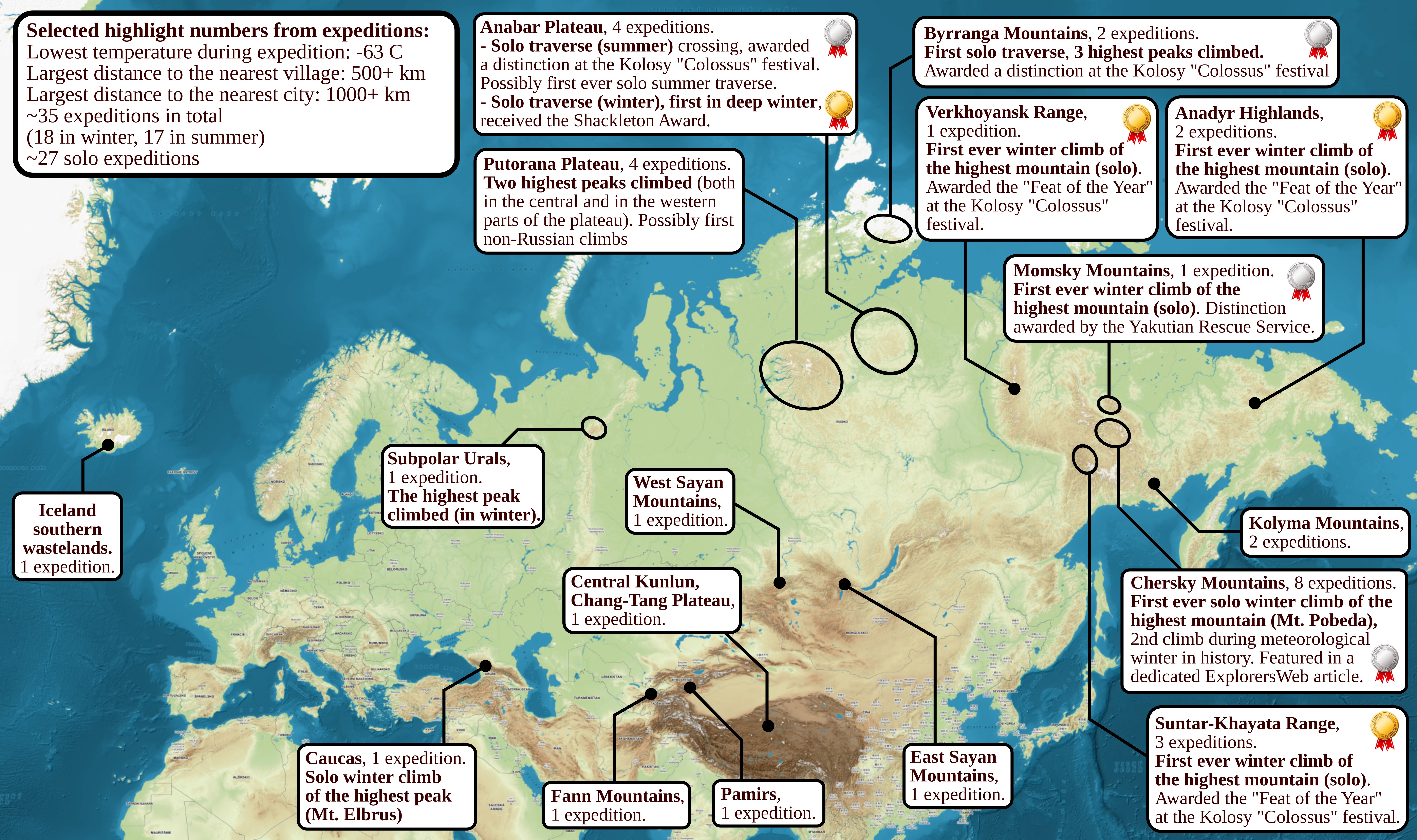
All expeditions are unsupported – I always organize and manage the logistics of the route myself, and do not use any form of external help during expeditions, besides the necessary local transportation (e.g., snow mobiles when approaching selected mountain massifs during expeditions that focus on climbing).
I collaborate with many companies:
>>> Check the partnership subsite for more information.
>>> You may also take a look at the equipment tests and recommendation.
Some of the most interesting expeditions so far are:
- The first ever solo winter climb of Mt. Pobeda in Chersky Range in Yakutia, one of the coldest mountains on Earth. Details coming soon.
- The first ever deep winter traverse of the Anabar Plateau, one of the great plateaus of Siberian Arctic. Details here.
- The first winter ascent (solo, early January) of Mus-Khaya, arguably “the coldest mountain of the northern Hemisphere” – the highest peak of the Suntar-Khayata range, one of the main mountain ranges of Yakutia, located in the Oymyakon District, where Oymyakon, a village referred to as “the Pole of Cold”, is situated. Temperatures down to -55 Celsius.
- The first winter ascent (solo, mid February) of another pretender to the title of “the coldest mountain of the northern Hemisphere” – the highest peak of the Verkhoyansk range, one of the main mountain ranges of Yakutia, located nearby Verkhoyansk, another village referred to as “the Pole of Cold”.
- The first traverse (solo) of the highest part of Byrranga Mountains, the northernmost continental mountain range (with climbing all highest peaks) located in the northernmost Siberian Arctic (these mountains are described in research papers as one of the most remote and least studied areas of the whole Arctic).
- A solo winter climb of Mt. Elbrus, the highest peak in Europe (done in a very fast style; the whole expedition took 2.5 days);
- The first winter ascent (solo, late January) of the highest peak (unnamed) in Momsky Mountains (a remote mountain range in Yakutia), with temperatures down to -55 Celsius;
- A “Marriage Expedition” – hitchhiking in winter conditions, on frozen rivers and across mountain passes (together with my fiancee) to deep taiga in Yakutia, getting married (a legally valid Catholic ceremony) at the bottom of the breath-taking Chersky Mountains, and having a memorable party with our befriended herders of reindeers;
- The first Polish winter ascent of Mount Narodnaya, the highest peak in the Ural Mountains.
>>> Check all these expeditions, and many others, here.
A never-ending source of inspiration and examples are the lives of the exploration giants, such as Fridtjof Nansen, Roald Amundsen, Ernest Shackleton, Richard Francis Burton, Wojciech Kurtyka, Reinhold Messner, Walter Bonatti, Jerzy Kukuczka, Naomi Uemura, Willem Barentsz, Semyon Chelyuskin, Sven Hedin, Henry Hudson, Valerian Albanov, Jan Czerski, and many others
>>> Click here if you want to check out my research website <<<
Omnipotens Deus: Ego coram te quaerere, eaque omnia pro auxilio ac patrocinio assequamur. Da mihi faciat propter magnam gloriam tuam.